Big Ideas

Five Ways of Thinking

Some ways of thinking matter in every subject. At Seattle Futures, five big ideas connect our English and math classes with every project students take on. Students practice them again and again, across three years and dozens of topics, until they become habits of mind.

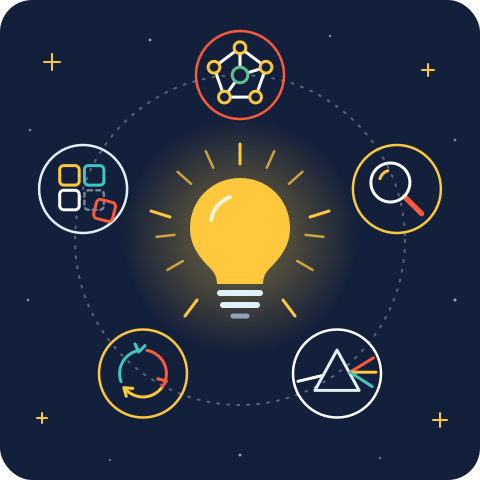
Illustration of a glowing light bulb circled by five line-drawn icons in colored rings: a network of connected nodes, a magnifying glass, a prism splitting light, a cycle of arrows, and blocks being taken apart and put back together
Big Idea 1

Connection Making

The most powerful ideas often come from linking things that seem unrelated.

Students learn to look for links between subjects, between the past and the present, and between what they study and the world around them. A pattern in mathematics might explain a rhythm in music, and a story from history might shed light on a debate in today's news. Over time, students build a web of knowledge in which every new idea has somewhere to connect, making their learning deeper, more lasting and more creative.

Big Idea 2

Evidence & Reasoning

Good thinkers ask how we know what we know.

Students learn to support their ideas with evidence and to look for the evidence behind the claims of others. They practice judging sources, separating fact from opinion, and building arguments step by step so that each conclusion follows from what came before. In a world full of information and AI-generated content, careful reasoning helps students think independently, change their minds when the evidence calls for it, and make a convincing case for what they believe.

Big Idea 3

Multiple Perspectives

Every important question looks different depending on where you stand.

Students learn to consider a question from many points of view: the people it affects, the disciplines that study it, and the times and cultures that have shaped it. They practice listening carefully, representing views they disagree with fairly, and weighing evidence before reaching their own conclusions. Over time, seeing from multiple perspectives makes students sharper thinkers, stronger collaborators and more thoughtful citizens.

Big Idea 4

Systems Thinking

Understanding a subject means understanding the systems that make it work.

Students learn to look beyond isolated facts and individual disciplines to understand how systems function, why they work as they do, and how their parts interact. Over time, they recognize patterns that recur across fields, see how a change in one part can affect the whole, and bring ideas from one discipline to bear on problems in another.

Big Idea 5

Analysis & Synthesis

Taking ideas apart and putting them together are two halves of understanding.

Analysis means examining something complex, such as a text, a data set, a machine or an argument, to see how its parts work. Synthesis means combining ideas, evidence and skills into something new: an essay, a model, a design or a solution. Students practice both in every subject, learning to move between close examination and creative construction, and to turn what they discover into original work.

Curious to learn more?

Come meet us at a Parent Information Session, or connect with us for admissions updates.